Do Not Disturb

A dense fog covered the downtown skyline, draping each building in its own gown of fluorescent light. The sun had yet to push through, lifting the veil to scattered palm trees to the west. On a clearer day, I had counted them. That morning, they were out of focus. The Coronado Bridge, with its right curve leading to a higher tax bracket just south, had disappeared completely. The air had the sobering bite of December, but lacked the heaviness to reach the bone.
I ordered a driver; he was military by the cut of his jib. He wore his hat tight, brim hiding his eyes, and had a deep and strong voice. He greeted me with a “good morning, Sir,” and drove his red Tacoma like we were rolling over bodies in a war zone.
As he sped onto the entrance of I-5 North at 19th and B Street, I looked out the window at the city-sanctioned homeless encampments, but they too were covered by the fog. I could see no halos of light from where the rows of tents should have been.
My driver careened into the departures area and punched the brakes in one smooth motion, finding a gap into which he could let me out on the curb. “Here you are, Sir. Good day,” he said.
Exiting the truck, I grabbed my bag, and I thanked him. He kept his head straight forward but gave a nod as I closed the rear door. The moment I let go of the handle, he was gone into the far left lane and out beyond the next curve.
I looked for Southwest, the airline with which my company had booked my flight. I had just one carry-on: my father’s French West Indies travel bag.
I’ve used the bag on every trip I’ve taken since his death. It has accompanied me as a child to sleepovers at friends’ houses. As a teenager, it was with me in Hawaii and Europe. As an adult, to New York three times, once driving from the west to the east coast and back in a van with my friend’s band. It accompanied me on a trip to Texas to finalize a relationship that had been slowly dying for years.
Inside the dark floral tapestry that with each passing year looks more like a used couch, were my clothes, Cormac McCarthy’s The Road, George Orwell’s Burma Days, and a manila envelope with documents that I hoped would get me through TSA security without my RealID.
These documents included my social security card, two bills addressed to me, one with my current and one with my former address. I attempted to find my birth certificate, a process that forced me to clean and organize my closet, which had become a wasteland for dirty clothes, pictures, and documents concerning my father’s death.
In the closet, I found five copies of my father’s death certificate, the police report, which included eyewitness testimony, and two copies of his birth certificate. One was the original from Würzburg, Germany, and a transferred United States version that was required when my grandmother and grandfather moved to Jersey City, New Jersey, after the war. I could not find a single document besides my social security card and bills that confirmed my identity.
I got through security without a hitch; they handed me a laminated red card and made me take off my shoes. They can confirm my identity better if they can see my socks.
Landing in San Jose, I changed into my business clothes. I had purchased hairspray, deodorant, and toothpaste at the Hudson Mart outside my gate, totaling twenty-three dollars. I used them all while watching strangers pass me in the bathroom mirror, growing increasingly aware that the San Jose Airport carries that beige malaise of an outdated infrastructure.
Carrying my father’s bag, I felt awkwardly one-sided. Everyone else had rolling backpacks and puffy vests. I ordered a car and headed to the jobsite, staring down into my phone, answering texts and looking at images of home.
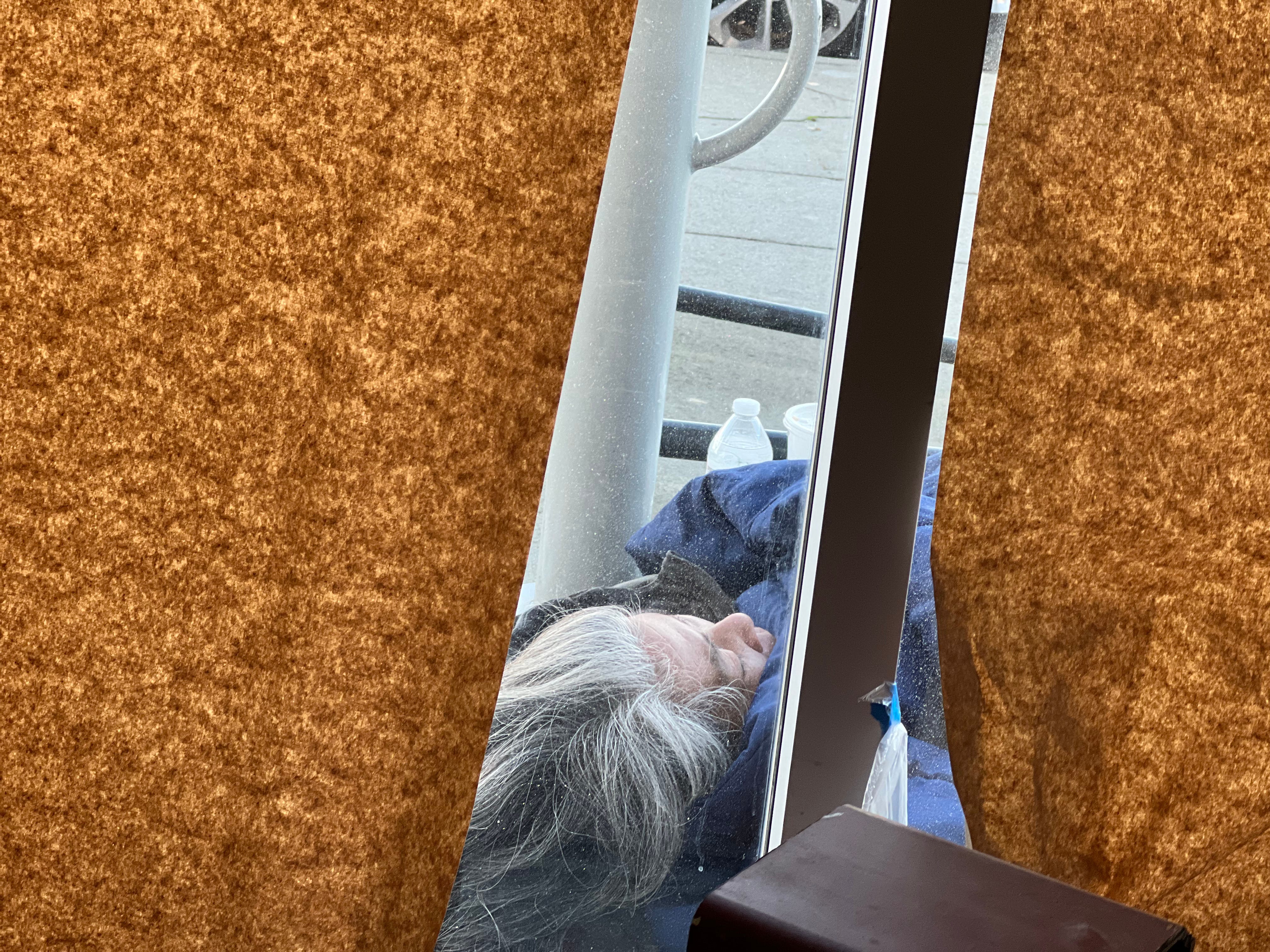
A woman was sleeping outside the left-hand corner of the jobsite with a shopping cart full of blankets and a tarp. Next to her head lay twenty or so empty fortune cookie wrappers, which I assumed must have been her dinner the night before. She was asleep but stirring.
When I walked in, I saw a large interior not unlike the Pasadena location I used to work at. I found Mark, with whom I’ve worked on two store builds before, and his new protege, Andy.
The first thing Mark said to me was, “I didn’t think you were supposed to be here until tomorrow.” I said, “Well, my flight was today, so I got on.”
He told me he didn’t have much for me because the electricians were “dragging ass.” Our job was to do what we could around them, which wasn’t much.
I had problems with the card that my company put on file to pay for my hotel room. Eventually, I was assigned room 413. Inside the elevator, I felt like the last person on earth.
The halls and my room were framed with pictures of computer chips, servers, and wires. It hadn’t occurred to me that I was in Silicon Valley. That explained all the buildings with names like Promex, Qualcomm, and Fortnet. They were scattered everywhere and looked abandoned.
This was the middle of corporate suburbia, with my hotel between “Golfland” and an Indian restaurant. I microwaved meals every night. There were no signs of anyone else on my floor. San Jose itself felt like one big gate at the airport. Everyone is waiting around for something to happen. The week blurred by, and I ordered another driver.
I tossed my father’s bag into the backseat of my driver’s car. I saw colorful frays that had unraveled themselves over the years, unnoticed until now.
My driver was on speakerphone with a customer service representative who could not understand him. My driver had a heavy Indian accent, and even I could not understand the name he was trying to relay to the man on the other side of the phone. He ended the call as quickly as possible and apologized.
“My father died last night, and I have to pick him up soon,” he said.
He was about sixty years old, and although he seemed the type not to divulge such information to a stranger, he had to tell someone. He stared straight forward as he told me, some signal of manhood only recognizable by the ability to not connect, even in moments of complete need.
I offered my condolences. I asked him where his father was. He lifted his right arm and, with his thumb pointed quickly behind his right shoulder. I did not turn and look behind me. Wherever his father was, we were heading in the opposite direction.
I decided it was best to offer my condolences one last time as I exited his car. He nodded, and I hoped someone better than me could allow him a shoulder to cry on. I pulled my father’s bag from his back seat and entered the airport, for once this whole trip, thinking about someone other than myself.
The person running the gate kept announcing that a dog was on the loose and that our flight was full. He needed volunteers to check their bags, or else we could not take off. I did not see the dog, and I did not volunteer to check my bag.
From the air during descent, I was able to triangulate my apartment and see it growing larger. I saw myself as a doll in a dollhouse, bag in hand, walking through the front door, living out traumas and victories with equal conviction.